
The Bronx Resident Lookup Coverage
A one-person search in The Bronx works best when each record has a narrow job. The NYC Department of Finance property tools can show an owner of record and parcel details. The Board of Elections status tools can test a supplied identity against registration data. A court index can show that a named party appears in a case, and archive indexes can place an event in time. None creates a complete list of everyone at an address. The table separates a useful confirmation from a claim the record cannot support.
| Record | What It Confirms | Where | Access |
|---|---|---|---|
| DOF/PIP assessment | Owner of record, parcel, and possible mailing address | NYC Property Information Portal | Public property fields; not a household roster |
| ACRIS deed index | Recorded party role, date, BBL, and legal chain | ACRIS | Free index for Bronx documents from 1966; copies follow portal rules |
| Voter status | A registration match and status when exact fields match | NYC voter lookup | Name, birth date, borough, and ZIP query; protected data withheld |
| Court index | Party role, case number, filing, status, or appearance trail | New York State eCourts | Portal-specific; clerk files may be needed |
| Vital index or certificate | A historical birth, death, or marriage event and related details | NYC Historical Vital Records | Historical series by year; later copies have eligibility and ID rules |
| License or entity filing | Public credential or business affiliation | NYSED verification | Public status, not a promise of a home address |
If the question is about a property relationship, begin with its address and borough-block-lot number, also called a BBL. If the person is checking their own registration, use the exact voter fields. For a historical identity, use an event year, relative, street, or occupation to test a match. A recorded party, business contact, owner, and resident are different roles. Keep that distinction throughout a resident lookup for The Bronx.
The Bronx Court Name Search
WebCivil Supreme is a Civil Supreme Court index, not a search across every Bronx court. Its party form accepts an index number, name, attorney name, or justice name. Optional controls include party role, one or more courts, filing year, case status, future appearances, sorting, and HTML or PDF output. WebFamily is narrower: it shows future appearances and supports file, docket, attorney, calendar, county, court location, date, judge, and part routes. NYSCEF guest search supplies another route for participating e-filed cases.
| WebCivil result field | What it means |
|---|---|
| Party name and role | How the person is indexed in the case, such as plaintiff, petitioner, defendant, respondent, or another role. |
| Index or case number | The court identifier used to retrieve a specific case path or ask a clerk for a file. |
| Court, county, and case type | The tribunal and category attached to the result, which help separate same-name parties. |
| Filing and appearance details | Dates, status, future-appearance indicator, calendar part, and justice where exposed. |
| Attorney and document links | Attorney or firm information and available links, including NYSCEF material when e-filed. |
A result is an index lead. It does not prove current address, misconduct, or the identity of a same-named person. Sealed matters, adoptions, youthful-offender records, many family details, Mental Hygiene Article 81 matters, and cases not yet entered can be absent. The separate statewide criminal-history route requires an exact name and date of birth, covers all 62 counties, costs $95, and excludes sealed records.
Note: A case number, party role, court location, and filing year are stronger match points than a name alone.
The Bronx Voter Status Check
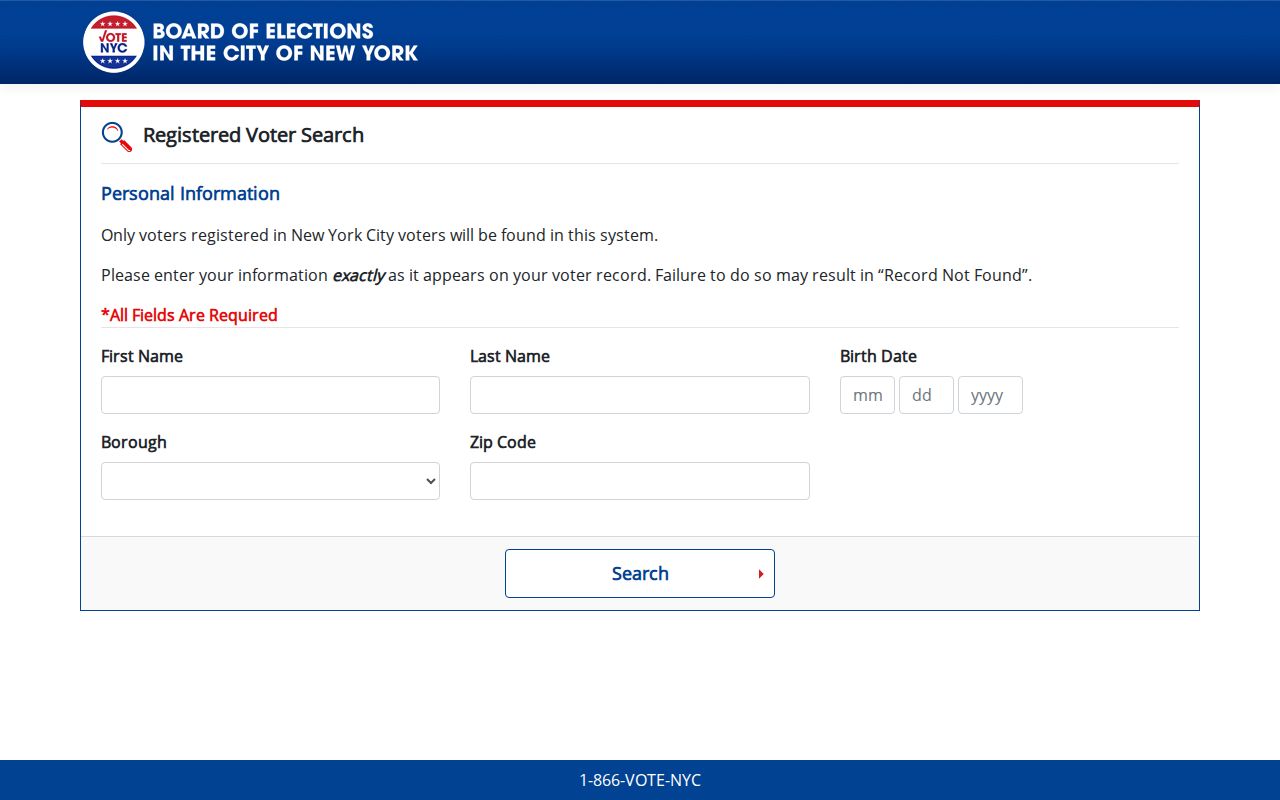
The NYC voter lookup requires first name, last name, birth date in MM/DD/YYYY format, borough, and ZIP Code. It tells the user to enter information exactly as it appears in the voter record, so a small difference can return Record Not Found. The statewide New York voter lookup likewise needs Bronx County, last name, first name, date of birth, and ZIP Code, with cookies and JavaScript enabled. These are status tools. They are not public name-and-address downloads.
The NYC voter-status form illustrates the exact-identity fields used for a resident lookup in The Bronx.
Use the borough and ZIP with the name and date of birth, then treat a match as registration information rather than a current-address conclusion. Registration can be active, inactive, cancelled, or otherwise ineligible for several administrative reasons. Election Law §3-220 makes registration records public under Board of Elections supervision, but identifiers such as Social Security, DMV license, non-driver ID, and facsimile numbers are withheld. Ballot choices are not a public voter-history field.
A full file may require a Board of Elections request and is regulated by Election Law §3-103(5), which bars treating it as a general contact database. The NYC Board of Elections FOIL form warns that voter registration information may not be used for non-election purposes, and knowing misuse can be a misdemeanor under Election Law §17-168. Confidential registration under Election Law §5-508 is another reason a no-match cannot establish nonresidency.
The Bronx Property Party Trail
Property evidence must be read by label. PIP searches a Bronx address through autocomplete, an intersection, or a BBL route and can return a property description, assessed value, exemptions, recent recordings, lot history, maps, and tax-map history. It does not offer a direct owner-name field in the inspected address and BBL screens. Convert the street address to a BBL, then use ACRIS party, date, or document tools for a legal-party trail. Search grantor and grantee separately because initials, punctuation, and abbreviations affect indexing.
The situs address is the parcel or building location. A mailing address is where notices may be sent. They can differ, and neither should be silently relabeled as a current residence. An exemption is tax status, not proof that a person occupies a building. ACRIS itself warns that public property records and a recorded instrument are not the same as a title search. When the BBL changes, inspect tax-map history and prior BBLs before treating the chain as finished.
Confirming The Bronx Resident Records
A reliable resident lookup in The Bronx starts by defining the person and year. Record a full name, middle initial, approximate age, known neighborhood or address, and whether the question is current status or historical identity. Search variants as well as an exact spelling. Accents, hyphenation, former names, initials, Spanish double surnames, and OCR mistakes can all hide the same person. Compare a date, relative, street, BBL, occupation, attorney, or court location before connecting two entries.
- Use an exact-match status tool only when the person supplied the required identity fields, or begin with an address and BBL instead of assuming a name-only hit is correct.
- Check PIP and ACRIS for a property relationship, keeping owner, recorded party, business agent, and occupant as separate roles.
- Search WebCivil, NYSCEF, or the relevant court path by party name, court, year, and status. Read the docket or clerk file only when the index points to the needed case.
- Use a historical vital index, directory, census, probate record, or obituary to test age, relatives, address continuity, and an estate or death endpoint.
- When official records conflict, ask the custodian about correction procedures and preserve both spellings in personal research notes.
- Docket
- The court's running case record, which may list filings, appearances, and other case events.
- Index
- A searchable pointer to a record. It identifies a result but may not contain the full document or all evidence.
- Image
- A scanned document attached to an index result when the custodian makes it available. Read it for the legal description or party detail.
- Certified copy
- A copy issued and certified by the record custodian for an official purpose. It is different from a screen image or index entry.
For an estate question, Bronx Surrogate's Court is the probate route. For a former classmate, yearbooks, school archives, NYPL newspapers, and alumni collections are better historical leads than a current-address claim. A business record can show an entity, agent, or public affiliation, but it should not be treated as a person’s residence.
The Bronx Vital Record Split
New York State's ordinary certificate route excludes New York City events. For The Bronx, the NYC Municipal Archives holds historical births from 1898 through 1909, deaths from 1898 through 1948, and marriages from 1898 through 1949. The HVR portal can search, browse by year and borough, and download digitized records where available, but online coverage remains incomplete. Reference-room and microfilm access at 31 Chambers Street are the fallback, especially for some pre-1898 registers.
Later New York City births and deaths go through DOHMH, while later marriages go through the City Clerk. Later copies have name-on-record, eligibility, ID, fee, and channel rules. FOIL is not the route for a vital certificate. A historical result can support identity work, but a certificate is handled by its custodian. The 2025 HVR update added 58,484 marriage licenses, including Bronx licenses from 1932 through 1937, so a past failed search is worth repeating.
For adoption information, the NYS Adoption Information Registry is the official eligibility-controlled route. It can provide nonidentifying, identifying, or medical information under its rules. It is not a public name search and does not issue original certificates.
The Bronx Special-Case Trails
Some searches need a narrower official channel. The New York State unclaimed-funds search can be filtered by last or business name, first name, city, ZIP Code, or a property ID from a Comptroller notice. It is free, updated daily, and may require relationship and identity proof after a match. It is useful for a former Bronx address but is not a general resident list. The official claim route is safer than responding to an unsolicited request for money.
Hart Island can provide a death or burial endpoint. The City-managed CMTS search supports name, age, birth date, death date, or Medical Examiner number for burials from 1977 onward. Earlier material routes through DORIS. A 1970s fire destroyed some records, so location information cannot always be determined. That documented gap is a reason to check DORIS, CMTS, and original archival records rather than treating a missing result as final.
The Bronx Clerk and FOIL Fallback
Online indexes are not complete case files. The Unified Court System directs searchers to the court clerk or County Clerk when material is not online, and public court terminals can show more docket detail than the web index. Ask the clerk about archived files and certified copies because procedures vary by division. Bronx County Clerk is at 851 Grand Concourse, Room 118, and lists Supreme Court and county-record functions. The office lists weekday hours of 9:00 a.m. to 4:45 p.m., with lunch from 1:00 p.m. to 2:00 p.m.
For agency records, New York Freedom of Information Law is N.Y. Public Officers Law Article 6, §§84-90. NYC agencies accept requests through NYC OpenRECORDS. A request should identify the record, date range, and agency instead of asking for an undefined profile of a person. The Board of Elections has its own request form and charges stated copying or preparation fees in the research record. Custodian channels are also where corrections, sealing questions, and redaction requests belong.
Note: Ask for the specific index, file, certificate, or correction route rather than assuming one portal covers every Bronx record.
The Bronx Lookup Privacy Limits
New York's Address Confidentiality Program, under Executive Law §108, provides an eligible participant a substitute mailing address and confidential legal-notice route. Confidential voter registration under Election Law §5-508 protects a qualifying voter’s address in ordinary voter-file release. Sealed court and vital material, withheld DMV identifiers, and protected archival fields have their own rules. A public result does not erase those limits, and a missing result may reflect confidentiality, a different spelling, a different year, or an unindexed record.
When information looks wrong or outdated, contact the office that keeps the source record: BOE for voter status, DOF or City Register for property, the clerk for court data, DORIS or DOHMH for vital material, and DOS or NYSED for license records. A suppression request to a commercial directory cannot correct an official record. Keep personal research focused on the least identifying fact needed for a lawful family, estate, archival, or safety purpose.
Lawful use. The Bronx resident lookup is for lawful personal research. New York Penal Law Article 120 and §240.26 do not permit stalking, harassment, intimidation, repeated unwanted contact, or disclosure of protected information.