
Finding The Bronx Resident Records
A residents directory search works best when it starts with a narrow question. An address can be resolved to a borough-block-lot number, called a BBL, in the Department of Finance property tools. A name can be tested against a court party index, a voter-status tool when the required information is known, or an older directory. Each result has a different meaning. A deed names parties to an instrument, an assessment identifies a parcel and its tax details, and a directory gives a dated snapshot rather than a current household list.
For a current property question, start with the address. For a historical household, start with the year and the address spelling used then. For a person, record a middle initial, approximate age, neighborhood, or known relative before opening a database. That context helps separate same-name results and avoids treating a mailing address, party name, or old directory entry as proof of present residence.
- Resolve a street address in the Property Information Portal or GOAT, and save the BBL or BIN shown by the official tool.
- Use that key in the property record and ACRIS to identify the parcel and recorded-document trail.
- For a known person, use the matching official status or court search and compare the result with a second identity marker.
- For an earlier era, move to NYPL directories, census material, newspapers, and historic property cards.
- When the web index stops, ask the custodian, library, archive, or FOIL office for the documented alternative channel.
The Bronx Address to BBL Route
The NYC Property Information Portal, often called PIP, is the practical entry point for an address in The Bronx. It accepts an address or a BBL and returns property details, assessment information, recent recordings, lot history, and tax-map history. The ordinary PIP screen does not offer a direct owner-name field. That matters because an address investigation and an owner-name investigation are different tasks in the Bronx.
Choose the suggested address from PIP's autocomplete list before searching. A result outside city limits is rejected, and a condominium, co-op, air lot, or subterranean lot can need its own specialized identifier. Once the portal returns a BBL, that parcel key can connect the finance record to ACRIS and building-history tools. A BIN, by contrast, identifies a building and is useful when looking at Department of Buildings records.
| PIP field | Use in a Bronx search | Format note |
|---|---|---|
| Address | Find the normal property route | Select the suggested NYC address |
| Borough, block, lot | Open a specific tax parcel | Select Bronx, then enter tax identifiers |
| Condominium or co-op number | Resolve specialized property relationships | Use the matching development identifier |
| Tax map history | Check lot and map changes | Read the available history tabs |
See the PIP search interface before entering an address. Its property choices show why the first step is identifying the parcel, not assuming that one street number has one simple ownership record.
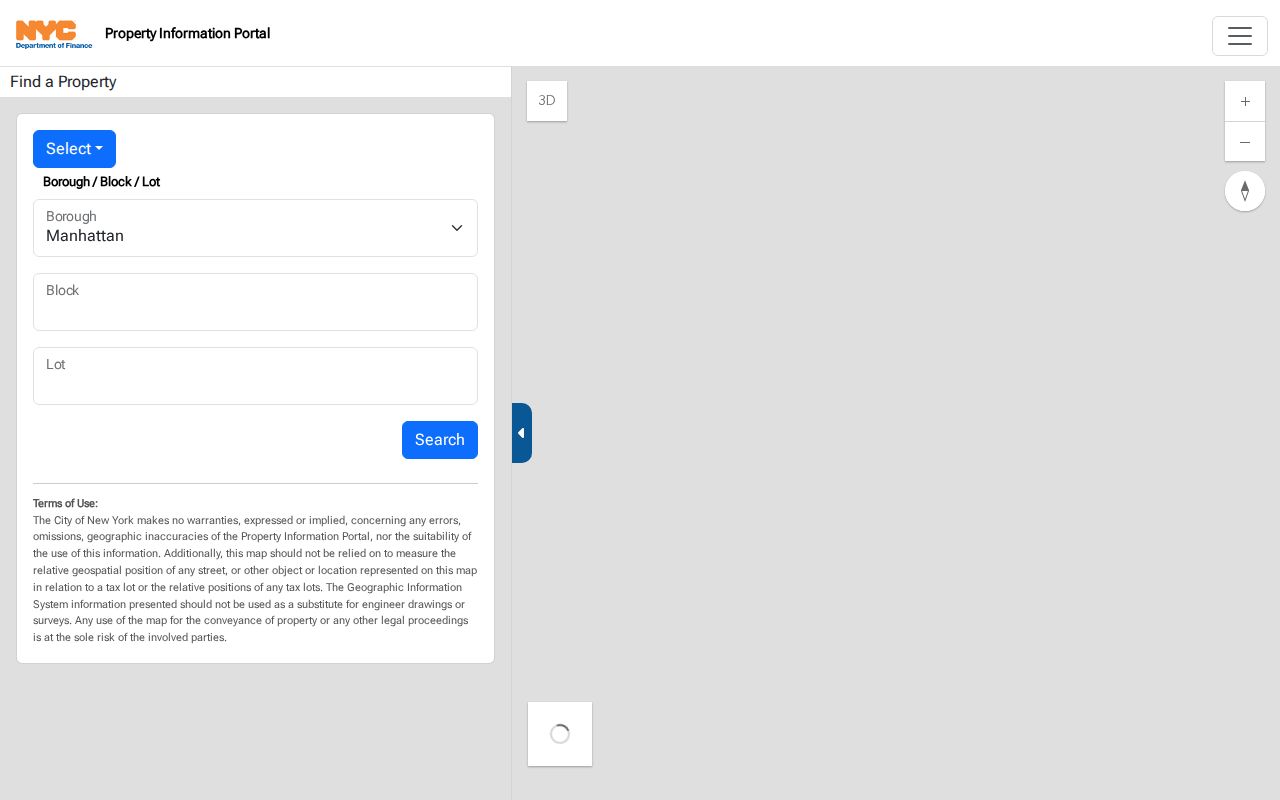
The portal screenshot illustrates the several address and identifier paths. Those separate routes are especially important for multi-unit and specialized Bronx property records.
The Bronx Resident Records Offices
The Bronx is both a New York City borough and a county. Its records are split among city and state custodians instead of a single county recorder. The Department of Finance and City Register hold the property and recorded-document paths, while the Bronx County Clerk is the county-office route for Supreme Court clerk records, naturalizations, business certificates, judgments, and liens. Election records follow a separate Board of Elections system. Use the office whose record type matches the question.
NYC Department of Finance
Property and assessment records
Address and BBL search route
Public portal access
NYC Board of Elections, Bronx
1780 Grand Concourse, 5th Floor
Bronx, NY 10457
718-299-9017
The Bronx ACRIS Party Trail
ACRIS is the City Register's public index for Bronx deeds, mortgages, leases, liens, and related instruments from 1966 forward. Begin with an address or BBL to locate the parcel, then use party, date, and document paths as needed. Read the recorded image and legal description, not just the line in the index. A document party may be a grantor, grantee, lender, trust, or business, and that role is not the same thing as living at the property.
For a backward property trail, open the newest recorded deed, note its grantor, grantee, date, document number, and legal description, then search the prior seller as an earlier grantee. Lot mergers, mortgages, and changes in a BBL can interrupt a simple name chain. Pre-1966 Bronx documents move to the City Register research library in Queens, property cards, archival material, or other historical sources. ACRIS screen copies are free; the documented City Register fees are $1 per page for uncertified paper copies and $4 per page for certified copies.
Start with the ACRIS address and BBL lookup when the parcel is known. The screen is a useful reminder that modern Bronx property research depends on both an address and the city tax-map identifiers behind it.
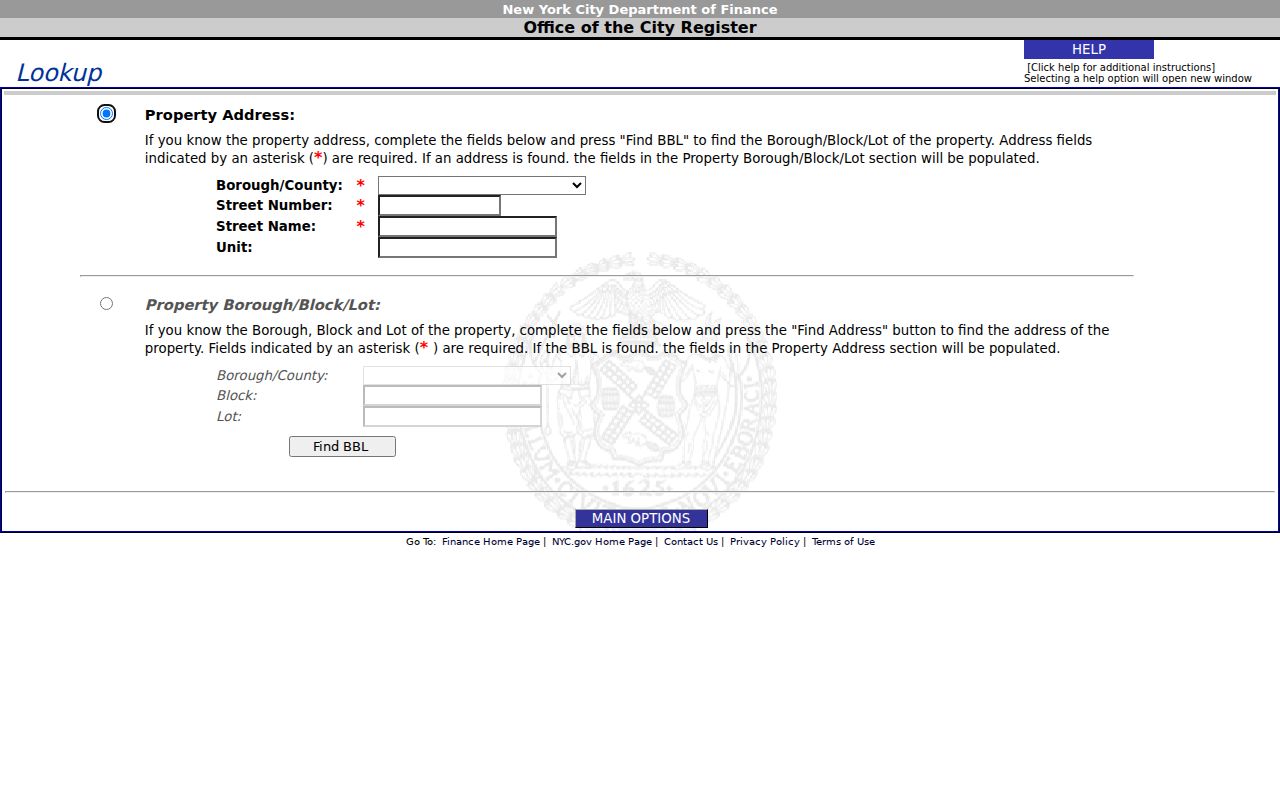
The address route can provide the bridge from a familiar building to a recorded-document search. It does not, by itself, establish an occupant list or a title opinion.
The Bronx Current Resident Directories
There is no verified official current directory of every Bronx household. Instead, several public sources answer narrower questions. Property records show the owner of record and parcel relationship. Recorded documents identify legal parties. Registration tools are designed for an exact voter-status query, not a directory download. Court and license indexes can corroborate an affiliation or filing, but each has its own public-access limit. A sound residents directory search keeps those roles separate.
| Bronx source | What it can establish | Custodian | Access route |
|---|---|---|---|
| PIP and assessment roll | Parcel, assessment, tax class, exemptions, and owner-of-record context | NYC Department of Finance | Free address or BBL portal |
| ACRIS | Parties to recorded instruments and document dates | NYC City Register | Free index and image route |
| Voter lookup | One matching registration-status query | NYS or NYC Board of Elections | Name, birth date, and geographic fields |
| WebCivil and NYSCEF | Party role, case, filing, and calendar leads | New York courts | Web index plus clerk-file fallback |
| License and entity indexes | Credential or public business affiliation | New York agencies | Agency-specific search tools |
A person whose name appears in one of these sources still needs confirmation through the original custodian and a second identifier. The The Bronx resident lookup details the person-first method without turning a property party or old database hit into a claim about a current private address.
Checking The Bronx Voter Status
New York election law makes registration records public under Board of Elections supervision, but the public web forms are deliberately narrow. The statewide tool asks for county, last name, first name, date of birth, and ZIP code. The NYC tool requires first name, last name, birth date, borough, and ZIP. A mismatch in spelling or the way the record stores an address can produce no result. The forms are for checking a record, not for browsing a neighborhood or creating a contact list.
| Lookup field | How the Bronx tools use it |
|---|---|
| County or borough | Select Bronx County on the NYS tool or Bronx on the NYC tool. |
| Name | Enter the voter-record spelling, including useful name variants when a first search fails. |
| Date of birth | Use the required MM/DD/YYYY format. |
| ZIP code | Supply the five-digit registration ZIP to narrow the status query. |
Open the New York State voter lookup only for the documented single-record query. Election Law §3-220 withholds DMV and Social Security identifiers, while confidential registration can protect qualifying voters from ordinary disclosure.
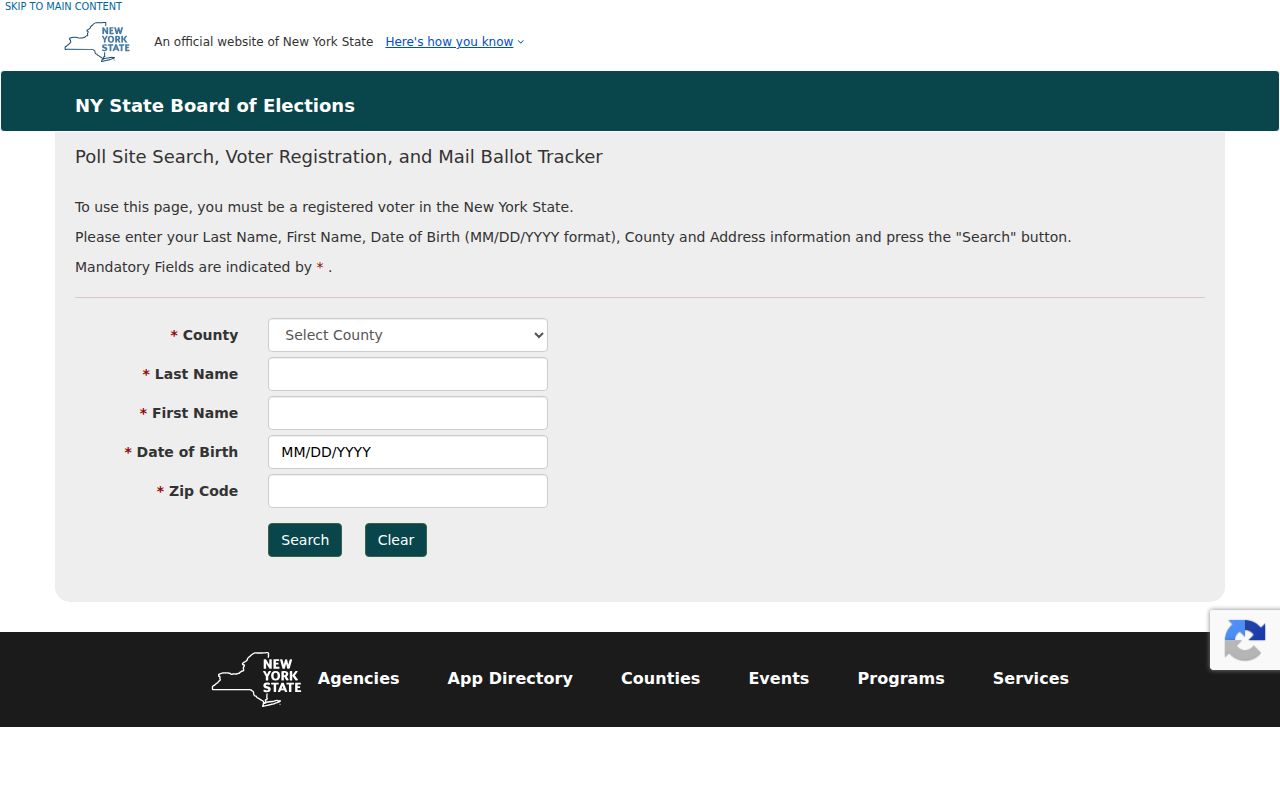
The form shows the combination of identity and geography fields used to avoid a name-only result. It does not reveal ballot choices or provide a street-wide roster.
The Bronx Court Party Indexes
For a civil court lead, New York eCourts links to WebCivil, WebFamily, WebCriminal, and other court paths. WebCivil Supreme supports a party-name route with optional role, court, filing year, case status, and future-appearance filters. It can show a party role, index number, court, case type, filing date, appearance information, and links where available. It cannot settle a question of current residence or conduct.
Same names are common. Compare a court result with the court, role, date, address-related property identifier, attorney, or another independent fact. Sealed matters, youthful-offender cases, adoptions, and many family or mental-health details are restricted or absent. When online material is incomplete, the relevant court clerk or Bronx County Clerk is the documented fallback, and public court terminals may show more docket detail than the web index.
Note: A court index hit is a research lead, not proof that a person lives at an address or that an allegation is true.
The Bronx Historical Resident Directories
Old city directories are dated evidence, not a modern roster. NYPL's digital New York City directory collection spans 1786 to 1934, and the Milstein Division retains city and state directories through the 1930s along with telephone backfiles, census material, newspapers, and microform. The Library of Congress also identifies Bronx address directories for 1931-1973, except 1934, and 1981-1991, except 1983. Its Bronx criss-cross run covers 1971-1996.
Search the alphabetical listing, then the street or reverse volume when it is available. An entry can carry a name, occupation, address, and publisher-specific notation, but it may identify an occupant, boarder, business contact, or an old copied entry. The fuller collection, publisher, and reading method belongs on the The Bronx city directory page.
The Bronx Date and Custodian Split
Dates decide which office holds a Bronx record. ACRIS begins online in 1966, while historic property cards cover roughly 1926-1991, with much of the collection from 1939-1975. The cards may hold names, conveyance notes, values, building class, sketches, and tax photographs. They can be ordered through the documented DORIS route for $18, using borough, block, and lot.
Vital records have an equally important divide. The NYC Municipal Archives holds Bronx births from 1898-1909, deaths from 1898-1948, and marriages from 1898-1949, with online coverage still incomplete. Later NYC birth and death certificates are handled by the Department of Health, later marriages by the City Clerk, and New York State's ordinary vital-record route excludes the five boroughs. A date and custodian are safer starting points than a broad name query.
The Bronx Record Terms
Several labels recur in public records and should not be treated as interchangeable. Knowing the label helps keep a search trail accurate when it moves from a map to a document index and then to a historical volume.
- BBL
- The borough-block-lot parcel identifier used by New York City property and map systems.
- BIN
- The building identification number used to connect a building to DOB records; it is not a parcel key.
- Grantor and grantee
- The party transferring an interest and the party receiving it in a recorded instrument.
- Criss-cross directory
- An address-first directory that can point from a street number to a historical listing.
- Situs address
- The physical parcel location, which can differ from the tax mailing address for notices.
When The Bronx Indexes Stop
Online access is broad, but it is not complete. Older deeds require the City Register research library or archival alternatives. A court result may require a clerk file. A historical vital search may move to the Municipal Archives reference room or microfilm. The Bronx Library Center supplies local history and reference help, while Milstein is the deeper city-directory and genealogy shelf. The Bronx Historical Society adds appointment-based catalog and finding-aid access for organizations, people, and borough history.
For existing city agency records that are not already published, use NYC OpenRECORDS to identify the agency and describe the record, date range, and available identifiers. New York's Freedom of Information Law, Public Officers Law Article 6, §§84-90, governs access to existing agency records, subject to exemptions. It does not require an agency to create a resident list or answer a research question.
The Bronx County Name Shift
Historical searches need the place name that a record used at the time. Areas west of the Bronx River were annexed to New York City in 1874, much of the east-of-river area in 1895, the borough was established in 1898, and Bronx County followed in 1914. A person associated with West Farms, Morrisania, or Kingsbridge before those changes may be indexed under Westchester County, New York County, a town, or New York City rather than a modern Bronx label.
That geography is more than local color. It explains why an apparently missing directory, vital, or court lead may turn up in a different catalog heading. Keep the original town label, street spelling, year, and source page in research notes. The 1935 Red Book street guide, Sanborn maps, and the historic directory sequence are useful bridges when a modern map and an older address do not line up.
The Bronx Archive Is Growing
Record availability changes. In 2025, the NYC Historical Vital Records project added 58,484 marriage licenses, including Bronx licenses from 1932-1937. Its 2025 DORIS reporting also described more than 2.3 million published records and 1.7 million remediated files since 2022. A previous search that found no online image can be worth repeating at the official archive.
Use the NYC Historical Vital Records portal to search or browse the digitized material by year and borough, then use its archival and reference-room routes for gaps. Treat a newly available image as a source to read carefully, with the date, borough, and record series preserved alongside the result.
The Bronx Special Record Endpoints
Some searches need a source outside the usual property-and-directory chain. The Hart Island CMTS can search post-1977 burial records by name, age, birth date, death date, or Medical Examiner number, with redactions and known historic gaps. It is a burial and archival lead, not a current-location source. Earlier material routes through DORIS and some records were lost in a documented 1970s fire.
For a former Bronx address connected to an unclaimed-property notice, the New York State Comptroller claim search is free. It accepts a last or business name, optional first name, city, ZIP, or property ID; a match still requires the claimant to provide proof through the official claim process. These specialized sources are useful when their record type fits the question, not as substitutes for the primary property, court, or archive record.